Reparenting Yourself: A Guide to Healing Old Wounds
There's a version of you that still remembers what it felt like to need comfort and not get it. Those moments don't always leave obvious scars, but they do show up in how you talk to yourself when you mess up, or how hard it is to believe you deserve good things.
Learning to reparent yourself is about finally showing up for that part of yourself, offering the care and reassurance you needed then and still deserve now.
Here's what reparenting actually looks like, and how you can start doing it today.
What Is the Inner Child?
We all have an inner child—a younger version of ourselves who still exists within us. In fact, we carry many versions of our inner child, representing all our different ages and stages.
Your inner child is the part of you that holds onto all your childhood experiences—the good, the bad, and the really messy. This part carries your old emotions and fears, your embarrassments and hurts.
Sometimes those old wounds stick with us into adulthood. They show up as anxiety, low self-esteem, or difficulties in relationships. You know that feeling when you get way too upset over something small? That's often your inner child speaking up, asking for something they never got.
Why Reparenting Works
When our emotional needs aren't consistently met in childhood—maybe our caregivers were inconsistent, unavailable, or even harmful—we develop patterns that follow us into adulthood. These patterns often look like people-pleasing, fear of abandonment, or avoiding emotional intimacy.
When you reparent yourself, you're addressing those unmet needs directly. You're telling your inner child, "Hey, I see you. I'm here for you now." This helps you shift out of those old patterns and move toward healthier relationships and a stronger sense of self-worth.
The beautiful thing is that our brains remain capable of healing throughout our lives. By consistently showing up for yourself with compassion, you actually rewire those old patterns and create new, healthier ones.
How to Reparent Yourself
Reparenting is about small, consistent actions that show your inner child they are safe, valued, and loved. Here's how to start:
Acknowledge and Connect
The first step is simply acknowledging that your inner child exists. When you have an emotional reaction that feels bigger than the situation, pause and ask: What is my inner child feeling right now? What do they need from me?
Try visualizing your younger self at a certain age. What did you look like? What did you need back then that you didn't get? This helps you see where your wounds come from and what still needs healing.
Practice Compassionate Self-Talk
Once you've connected with your inner child, you can change the way you talk to yourself. Think about how you'd speak to a child who's hurt or scared—you'd be gentle, patient, and understanding.
Start speaking to yourself the same way:
- "It's okay to feel this way."
- "I'm here for you."
- "You're safe, and you're doing your best."
This compassionate self-talk creates the emotional safety that heals old wounds. Every time you catch yourself in harsh self-criticism, pause and ask: Would I say this to a frightened child? If not, rephrase it with kindness.
Meet Your Own Needs
As you reconnect with your inner child, you'll start to notice what you need that's been missing. When you're feeling down, anxious, or overwhelmed, ask yourself: What do I need right now?
It could be as simple as a break, a hug, or a moment to breathe. Maybe it's asking for help, taking a nap, or letting yourself cry. By meeting your own needs instead of pushing through or ignoring them, you build trust and security within yourself.
Your inner child learns: My feelings matter. I deserve care. I can rely on myself.
Reconnect with Play and Joy
Many of us learned early on that we needed to perform, achieve, or be "good" to earn love and approval. In the process, we buried the parts of ourselves that felt too silly, too sensitive, or too much.
Your inner child needs fun and joy! Give yourself permission to play—whether it's art, music, dance, or something wonderfully silly.
What did you love to do as a child? What did you hide or push down in order to be approved of? Reconnect with those things now. Playfulness nurtures your inner child and helps you remember who you were before you believed you needed to perform to be worthy of love.
Set Healthy Boundaries
Once you've started building trust with your inner child through these practices, you can deepen that trust by setting healthy boundaries with friends, family, and work.
Every time you set a boundary, you're telling your younger self, "You deserve to be safe and respected."
If you struggle with saying no, think of it as protecting your inner child. Would you let someone treat a child in your care this way? If not, it's okay to say no to protect yourself.
Try Visualization and Letter-Writing
Sit quietly and visualize your younger self. See them clearly—what they're wearing, how they're standing, what expression is on their face. Offer them love and reassurance. Tell them what they needed to hear but never did.
Or try writing a letter to your inner child. Let them know that you see them, you're sorry they had to go through what they did, they're not alone anymore, you’re here now, and you're not leaving.
These practices help you process old emotions and bring closure to painful experiences that may have been stuck inside you for years.
What Changes When You Reparent Yourself
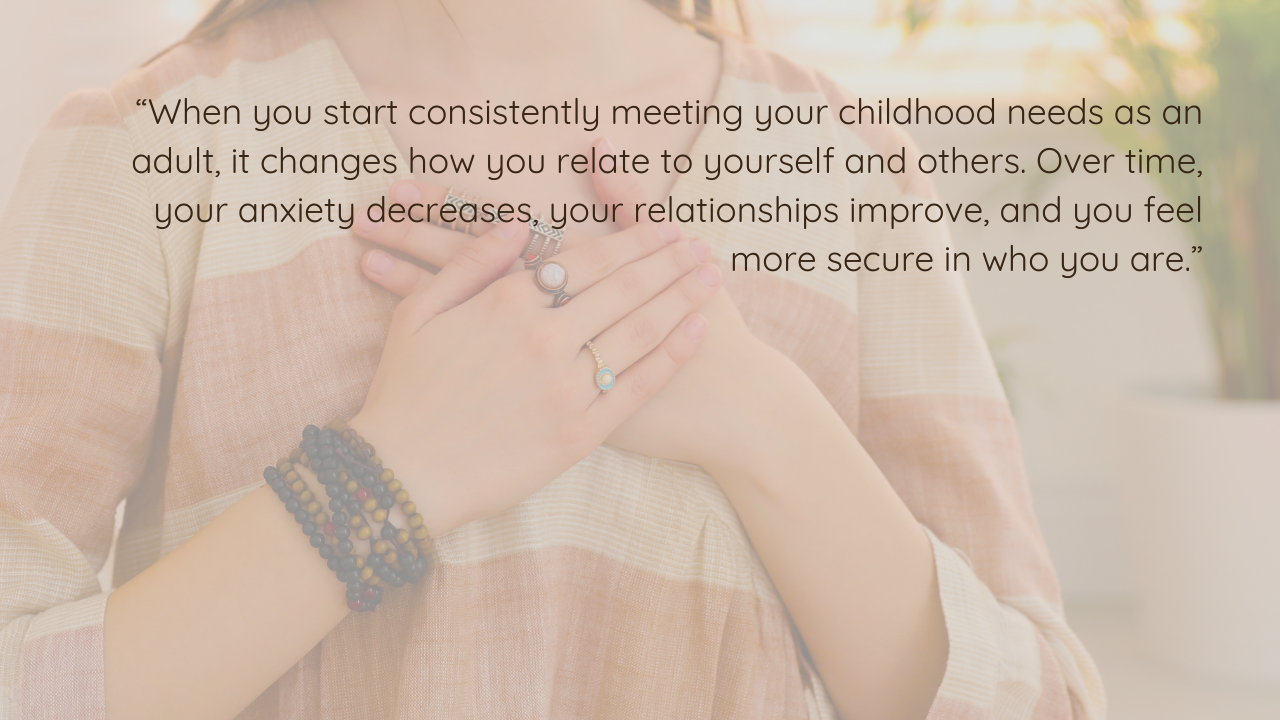
When you start consistently meeting your childhood needs as an adult, it changes how you relate to yourself and others. Over time, your anxiety decreases, your relationships improve, and you feel more secure in who you are.
You stop looking outside yourself for validation you can give yourself. You stop tolerating treatment you don't deserve. You start trusting your own judgment and honoring your own feelings.
Healing your inner child won't happen overnight. But the small, loving actions you take each day will have a lasting impact.
By stepping in as your own caregiver, you're giving your younger self the gift of the love and security they've always deserved.
It's never too late to become the loving caregiver your inner child needs. So go ahead. Give that inner child a hug. They've been waiting for you.
If you're ready to deepen this work, I'm here to help. As a yoga therapist, I work with people who feel anxious, overwhelmed, or stuck—helping them learn to work with their nervous system, not against it. Through gentle, body-based practices, I support you in building resilience, restoring a sense of safety, and reconnecting with the parts of yourself that need healing.
If you’re curious about a more compassionate, body-focused approach to anxiety, I’d like to invite you to join my online community The Inner Calm Collective.
Start with the free Inner Calm Collective membership tier and when you’re ready for more guidance, join the Elevated Membership for live classes, deeper support, and a space where your healing is fully supported.
Join Our Free Online Community!
You don’t have to do this alone. Inner Calm Collective is our online membership community where you’ll get expert tips, tools, and insights on healing anxiety, trauma, and building nervous system resilience.
Get the support and guidance you need to ease stress, calm your nervous system, and feel more at home in your body—every single day. Join now and start feeling the difference today!