The Thinking Trap: How Overthinking Becomes a Habit That Feeds Anxiety

You've been lying awake for an hour, replaying a conversation from three days ago. You've mentally rehearsed every possible outcome of a decision you won't need to make until next week. You've quietly dissected a text message, word by word, until the meaning feels completely unknowable. Sound familiar? This is overthinking, and for millions of people, it isn't just an occasional frustration. It's a deeply ingrained pattern, one that feeds anxiety in ways that can quietly take over daily life.
What's important to understand, and what often gets overlooked, is that overthinking is not simply a personality flaw or an innate temperament. For most people, it is a learned behavior. It developed over time, usually in response to real circumstances, and it got reinforced because, at some point, it felt like it was keeping you safe.
Where Overthinking Comes From
Overthinking rarely appears out of nowhere. For many people, it begins in environments where unpredictability was the norm: a household marked by conflict, emotional inconsistency, or high parental expectations. When a child grows up never quite knowing what to expect, the mind learns to scan obsessively for threats and warning signs. Hypervigilance becomes a survival strategy.
Others develop the habit through early experiences of failure or embarrassment. If a mistake once led to humiliation in a classroom, in front of a parent, or among peers, the brain draws a lesson: thinking more, preparing more, and analyzing more will prevent that pain from happening again. Over time, this belief calcifies into a default operating mode.
Cultural conditioning plays a role, too. Many people are raised in environments that prize perfectionism, self-criticism, or constant productivity. In these settings, sitting quietly with uncertainty is framed as laziness, while endless mental preparation is quietly rewarded. The message absorbed is simple: the more you think, the more in control you are.
Why the Brain Keeps Doing It
The cruel irony of overthinking is that it feels productive. When you're running through every possible scenario or trying to perfect a plan, your brain is generating activity. That activity creates a momentary sense of control, a brief reduction in the discomfort of uncertainty. And because anxiety is a response to perceived threat, anything that briefly reduces that feeling gets reinforced.
This is the mechanism that makes overthinking so sticky. It's not a random habit; it's one the brain actively rewards through short-term relief. The problem is that the relief never lasts. The worry returns, often louder, and the cycle begins again. Over time, the threshold for what triggers rumination gets lower and lower, until nearly any uncertainty or ambiguity can set the loop in motion.
Neuroscience supports this pattern. Repeated thought patterns strengthen neural pathways, and the more a circuit fires, the more automatic it becomes. What began as a conscious, effortful strategy eventually runs on autopilot. By the time most people seek help for anxiety, they've spent years, sometimes decades, reinforcing these grooves in the brain.
The Anxiety Connection
Overthinking and anxiety are not the same thing, but they are deeply entangled. Anxiety creates the urgency to think more: to solve, prepare, or protect. Overthinking, in turn, sustains and amplifies anxiety by keeping the threat-detection system permanently switched on. The two reinforce each other in a loop that can feel impossible to interrupt.
Chronic overthinking also tends to distort thinking itself. Rumination, or dwelling on the past, fuels guilt and regret. Worry, or catastrophizing about the future, fuels dread. Neither engages with the present moment in any meaningful way. Over time, the overthinker loses confidence in their own judgment, because their mind has spent so long questioning every instinct and second-guessing every choice.
Breaking the Pattern Is Possible
Because overthinking is a learned behavior, it can be unlearned, or at least interrupted and reshaped. The first step is recognizing it as a pattern rather than a character trait. You are not simply "a worrier." You developed a strategy that made sense in a particular context, and that strategy has outlived its usefulness.
Cognitive behavioral approaches help people identify the specific thought distortions driving the loop, such as catastrophizing, black-and-white thinking, and mind-reading, and replace them with more grounded responses. Mindfulness-based practices work differently but complement this well, training attention to return to the present instead of spiraling into hypotheticals.
Tolerating uncertainty is perhaps the most important skill to develop. At its root, overthinking is an attempt to eliminate the discomfort of not knowing. Learning to sit with that discomfort, to recognize it as temporary and manageable, is what ultimately defuses the cycle. This is uncomfortable work at first, but it becomes easier the more it's practiced.
Overthinking likely felt necessary at some point in your life. It was, in its own way, a form of self-protection. Understanding that is not an excuse to keep doing it; it's an act of compassion that makes it easier to let it go. The goal isn't to stop thinking. It's to stop letting your thoughts run you.
I’m a yoga therapist, and I help people who feel anxious, overwhelmed, or stuck learn how to work with their nervous system — not against it. Through gentle, body-based practices, I support you in building resilience, restoring a sense of safety, and finding more ease in everyday life.
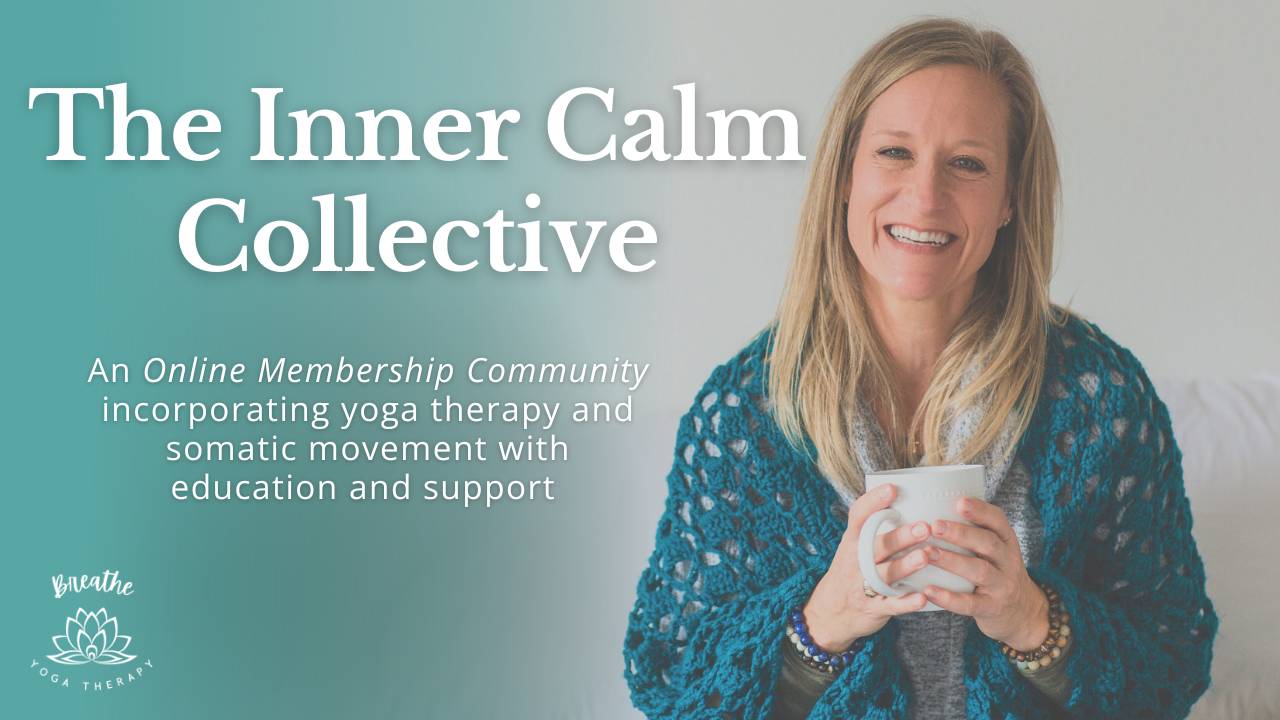
If you’re curious about a more compassionate, body-focused approach to anxiety, you’re not alone. I’d like to invite you to join my online community The Inner Calm Collective.
Start with the free Inner Calm Collective membership tier and when you’re ready for more guidance, join the Elevated Membership for live classes, daily practices, deeper support, and a space where your healing is fully supported.
Join Our Free Online Community!
You don’t have to do this alone. Inner Calm Collective is our online membership community where you’ll get expert tips, tools, and insights on healing anxiety, trauma, and building nervous system resilience.
Get the support and guidance you need to ease stress, calm your nervous system, and feel more at home in your body—every single day. Join now and start feeling the difference today!